Remediation (--fix)
scan --fix proposes — and, after you confirm, applies — safe, reversible fixes
for a small set of problems kubeagent already detects.
Warning
Remediation is the only feature that writes to your cluster — --fix,
and --rollback, which undoes what a previous --fix recorded in its audit
log. The two are mutually exclusive, and no other flag on any command
writes. Without them, kubeagent is strictly read-only. Every write is
deterministic (never decided by --explain or any model), drawn from a
fixed allowlist, and applied only after a per-action confirmation.
The actions
Only these actions are ever planned or applied — nothing outside the allowlist:
| Action | Proposed when | What it does | kubectl equivalent |
|---|---|---|---|
RolloutUndo |
a Deployment is degraded (Ready < Desired) because its newest rollout cannot pull its image, and a prior revision exists | rolls the Deployment back to its previous revision | kubectl -n <ns> rollout undo deployment/<name> |
Uncordon |
a node is cordoned (SchedulingDisabled) with no NoExecute taint |
makes the node schedulable again | kubectl uncordon <node> |
A rollout that is stuck on ImagePullBackOff but whose previous revision is still
serving (Ready == Desired) is not rolled back — the app is not down, so the
image is left for you to fix forward.
An accidental cordon is uncordoned; a deliberate drain (which carries a
NoExecute taint) is left alone.
Guard rails
- Opt-in. Writes happen only with
--fix; the default is read-only. - Per-action confirmation. Each fix prints its target, reason, and
kubectlequivalent, then promptsApply? [y/N]— the default is No. - Protected namespaces. Remediations never target
kube-system,kube-public, orkube-node-lease. - Apply-time re-check. Just before writing, the problem is re-verified against live cluster state; if it has already resolved, the action is skipped with no write.
- Single write per action. One API update — nothing cascading.
- Never model-decided. The plan is pure, deterministic logic.
--explainis never consulted, and no model ever influences a write.
Preview and non-interactive
# show what would be done — write nothing, never prompt
./kubeagent scan --fix --dry-run

# apply every proposed fix without prompting (CI / scripted use)
./kubeagent scan --fix --yes
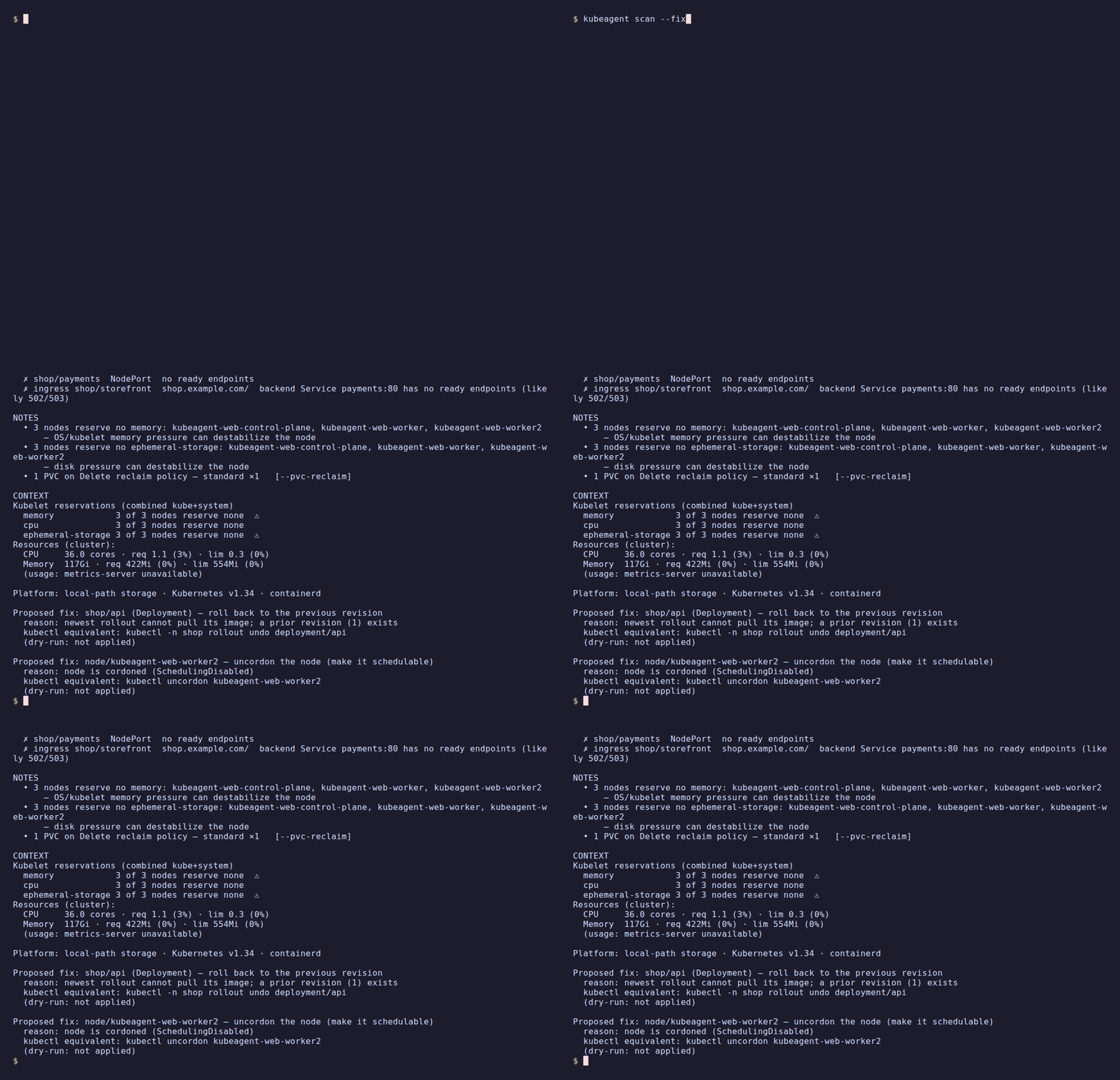
--fix --dry-run against a cluster with a bad rollout and a cordoned node: it runs the
normal scan, then lists the proposed fixes — a RolloutUndo and an Uncordon — and
exits without writing anything:
The preview is a contract
Every proposed fix includes a curated will change: diff — the revision line,
a per-container image change (image (name): old → new), and a count-only
N other template fields changed line for anything else — computed at plan
time, before Apply? is shown. Only safe, structural fields are diffed: env
values and template contents are never shown.
Apply is bound to that preview. Just before writing, kubeagent re-checks the
live revision and pod-template hash. If the cluster has moved — a new rollout
landed, or the target revision is gone — the action is refused with
state changed since preview … no write made and rendered as skipped:. To
retry, re-run the scan so a fresh preview is computed against current state.
Example
Proposed fix: shop/web (Deployment) — roll back to the previous revision
  reason: newest rollout cannot pull its image; a prior revision (1) exists
  will change:
    revision: 2 → 1
    image (web): registry.example.com/web:v2 → registry.example.com/web:v1
  kubectl equivalent: kubectl -n shop rollout undo deployment/web
  Apply? [y/N] y
  applied: rolled back shop/web to revision 1 (pod template restored)

Proposed fix: node/worker-1 — uncordon the node (make it schedulable)
  reason: node is cordoned (SchedulingDisabled)
  will change:
    spec.unschedulable: true → false
  kubectl equivalent: kubectl uncordon worker-1
  Apply? [y/N] y
  applied: uncordoned node worker-1
When nothing is safely fixable, kubeagent says so and writes nothing:
RBAC preflight
Before attempting each write, kubeagent runs a SelfSubjectAccessReview (SSAR)
to confirm that the current credentials are permitted to perform it — for example,
update on the target Deployment in namespace shop, or update on the target
Node.
Denied — refused up front. If the SSAR returns a denial, the action is skipped before any write is attempted:
The outcome is recorded in the audit log with the new preflight disposition — a
clean up-front refusal instead of a mid-apply 403.
Fail-closed on SSAR error. If the SelfSubjectAccessReview API call itself
fails (the API server is unreachable, a transient error), kubeagent fails closed:
no write is attempted and the outcome is recorded with the error disposition.
Under --dry-run. The preflight check runs in dry-run mode too (read-only).
Depending on what the SSAR returns, the dry-run line reports one of:
(dry-run: not applied; you have permission to apply this)
(dry-run: not applied; would be blocked — you lack permission to update deployments in namespace "shop" (RBAC))
(dry-run: not applied; permission check errored: <detail>)
No extra RBAC required. The SelfSubjectAccessReview is a self-check —
querying your own permissions — and create selfsubjectaccessreviews is granted
to all authenticated users by the built-in system:basic-user ClusterRole.
kubeagent does not need any additional RBAC to run the preflight.
Audit log (--audit-log)
--audit-log <path> (used together with --fix) appends a durable,
append-only JSON-Lines record of every remediation outcome — one line per
action — to the file you name. The log is written whether the action was
applied, declined, skipped as a dry-run, or refused by a safety guard.
Each record is a single JSON object on its own line:
{"time":"2026-07-24T06:30:00Z","kind":"RolloutUndo","namespace":"shop","name":"web","target":"shop/web (Deployment)","changes":[{"field":"revision","from":"5","to":"4"},{"field":"image (web)","from":"registry.example.com/web:v2","to":"registry.example.com/web:v1"}],"disposition":"applied","detail":"rolled back shop/web to revision 4 (pod template restored)"}
{"time":"2026-07-24T06:31:00Z","kind":"Uncordon","name":"worker-1","target":"node/worker-1","disposition":"refused","detail":"node is no longer a safe uncordon target (already schedulable or NoExecute-tainted); no write made"}
Disposition vocabulary:
| Disposition | When it appears |
|---|---|
applied |
The write succeeded. |
dry-run |
--dry-run was set; the action was planned but no write was made. |
declined |
The operator answered N (or pressed Enter) at the Apply? [y/N] prompt. |
refused |
A safety guard fired at apply time (cluster state drifted, or a nil-error "no write made" condition); no write was made. |
preflight |
The RBAC preflight (SelfSubjectAccessReview) denied the action before any write was attempted. |
error |
The write was attempted but the API server returned an error; or the SSAR itself failed (fail-closed). |
rollback |
A --rollback invocation successfully applied the inverse of the most recent applied record. |
Properties of the audit file:
0o600, append-only. The file is opened with mode0o600(O_APPEND), so only the process owner can read it and concurrent runs safely interleave.- Records every disposition. Every outcome — including dry-runs and user-declined actions — is logged, giving a complete picture of what kubeagent proposed and what happened.
- Fails fast. If the path is unwritable, kubeagent reports the error and exits before any scan or write begins.
- Secret-free by construction. Only the previewed diff values (the same
fields shown in the
will change:block), the action metadata, and the result detail are recorded. Env values and template contents are never captured.
Rollback (--rollback)
kubeagent scan --rollback --audit-log /var/log/kubeagent-fix.log reads the
most recent applied record from the audit log and proposes its deterministic
inverse:
RolloutUndo→ roll forward — a Deployment that was rolled back is rolled forward to the revision it was on before the fix (i.e. it restores the image/template that the--fixhad rolled away from).Uncordon→ re-cordon — a node that was uncordoned is cordoned again.
Guard rails (same as --fix)
The inverse runs through every guard rail that --fix uses:
- Curated
will change:preview diff — for examplerevision: 4 → 5. [y/N]confirmation — or--yesto skip.- Drift bond — if the cluster has moved since the original fix was applied (the revision is already gone, or the node is already cordoned), the rollback is refused with a clear message and no write is made.
- RBAC preflight — a
SelfSubjectAccessReviewconfirms write permission before any write is attempted. - Audit record — the outcome is appended to the audit log with the new
rollbackdisposition.
Sample proposal
Rolling back the fix applied at 2026-07-24T06:30:00Z
Proposed rollback: shop/web (Deployment) — roll forward to the pre-fix revision
  reason: undo the fix that rolled shop/web back from revision 5 to 4
  will change:
    revision: 4 → 5
  kubectl equivalent: kubectl -n shop rollout undo deployment/web --to-revision=5
  Roll back? [y/N] y
  rolled back: rolled shop/web forward to revision 5 (pre-fix pod template restored)
Notes
- One action per invocation.
--rollbackproposes the inverse of the single most-recentappliedrecord. Re-run to walk further back. - Requires
--audit-log.--rollbackhas no way to find the record to undo without the audit log path; the flag is required. - Mutually exclusive with
--fix.--rollbackand--fixcannot be combined in a single invocation. --dry-runis supported. Reports the proposed inverse without writing.- Pre-v0.54 records refused. The inverse is derived from structured
fromRevision/toRevisionfields written into every audit record starting in v0.54. Records written by an older build lack those fields and are refused with a clear message —--rollbacknever guesses the inverse from free-text detail. - Rollback records are not themselves reversible.
--rollbackonly matchesappliedrecords; arollback-disposition record is never the target. If you re-run--rollbackafter a successful rollback,ReadLastfinds the originalappliedrecord again and re-proposes the same inverse — the drift bond or the already-cordoned guard will normally refuse it.
JSON output (--output json)
With --output json, the remediation plan is included in the scan result as
remediationPlan — an array of proposed actions, each with status: "proposed".
The audit log (--audit-log, described above) records the outcome of each of these actions.
{
  "remediationPlan": [
    {
      "kind": "RolloutUndo",
      "target": "shop/web (Deployment)",
      "summary": "roll back to the previous revision",
      "reason": "newest rollout cannot pull its image; a prior revision (1) exists",
      "kubectlEquivalent": "kubectl -n shop rollout undo deployment/web",
      "changes": [
        { "field": "revision", "from": "2", "to": "1" },
        { "field": "image (web)", "from": "registry.example.com/web:v2", "to": "registry.example.com/web:v1" }
      ],
      "status": "proposed"
    }
  ]
}